Dispersive readout in brief
In circuit QED, a superconducting qubit is coupled to a resonator. A microwave probe reflects with a state-dependent phase and amplitude. Electronics record a short I/Q time series; a discriminator turns that series into a label.
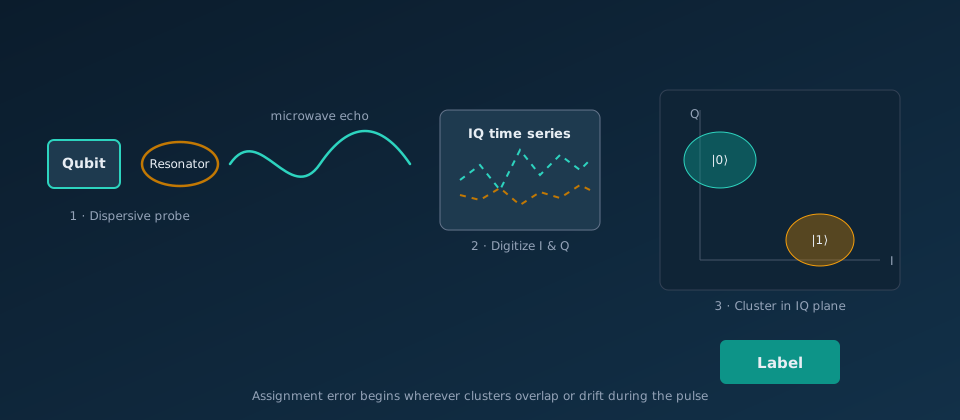
The IQ trace is the evidence. Assignment error starts here.
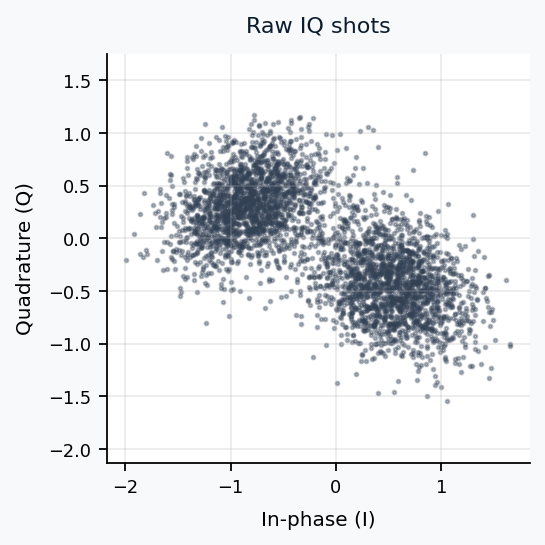
All shots in the IQ plane — no state labels.
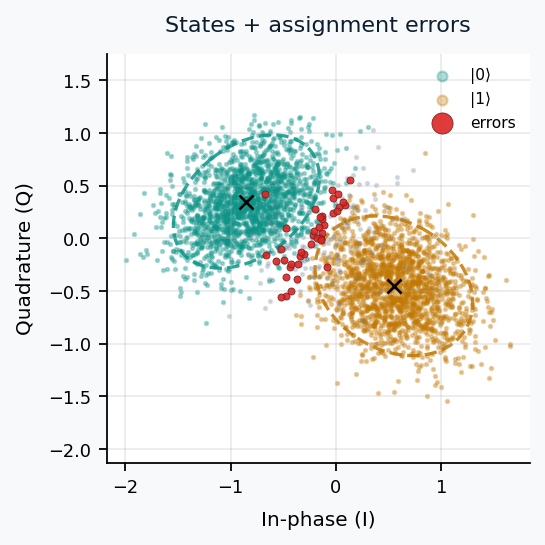
Colored by true state; red points are nearest-centroid assignment errors.
Five-transmon multiplexed readout: overlap between clouds is the classifier’s problem.
Three error channels
Relaxation, excitation, and leakage leave different fingerprints on the trajectory. Integration time trades accuracy for idle exposure — which is why NISQ and FTQC optimize different endings.
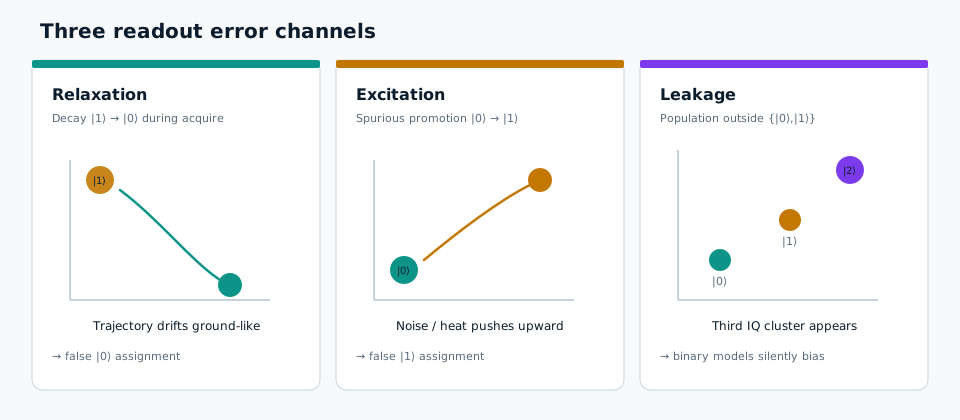
Relaxation
Decay during acquire
An excited qubit decays while the probe integrates, so the path looks partly ground-like and binary cuts misfire.
Excitation
Spurious promotion
Noise or heat pushes |0⟩ toward |1⟩, creating false positives that look like gate failures downstream.
Leakage
Leaving {|0⟩,|1⟩}
Higher levels form a third cluster. Binary models fold leakage into two-level error; multi-level methods label it explicitly.
Two system endings
NISQ · accuracy vs latency
On noisy intermediate-scale processors, choose an operating point under your coherence budget. Higher accuracy usually costs more inference latency.
Filter-only and compact hybrid methods cluster toward the low-latency side; heavier networks sit farther right when fabric estimates grow.
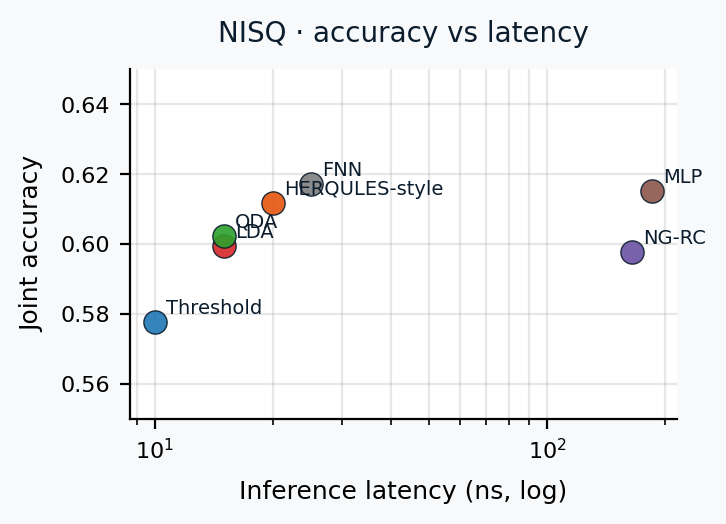
Reference methods under the shared protocol.
FTQC · logical error vs duration
With physical noise held fixed (no idle scaling), longer integration improves assignment and therefore lowers logical error rate across the full acquire window.
When idle scaling is enabled instead, shorter readout can win — that alternate ending lives on the FTQC goals page.
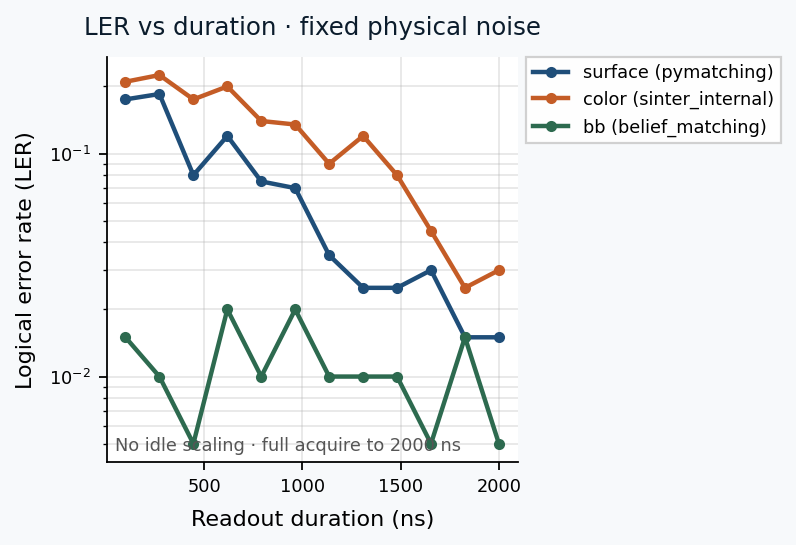
Fixed p_phys · full window to 2000 ns · legend outside the axes.
- Same pipeline, different goals. NISQ optimizes useful fidelity under latency; FTQC optimizes logical error under cycle time.
- Physics-aware features help. Matched filters and hybrids exist because relaxation and excitation are not generic noise.