Classical baseline
Matched-filter threshold
Per-qubit score cut after a matched-filter bank. Fastest classical reference for latency-sensitive stories.
Home · Classifiers
Methods
Each method is a replaceable block after shared data preparation. Features are built once for the method’s kind — filter scores, flattened IQ, or time-resolved sequences — then fit and predict run under the same evaluation recipe.
The experiment freezes demodulation, train/validation splits, and metrics. What changes between papers is where the discriminator attaches: after a matched-filter bank, on raw IQ trajectories, or on an expanded hybrid feature map. Hardware cost and system checks consume the same prediction stream.
Shared preparation — every method sees the same demodulated traces and splits.
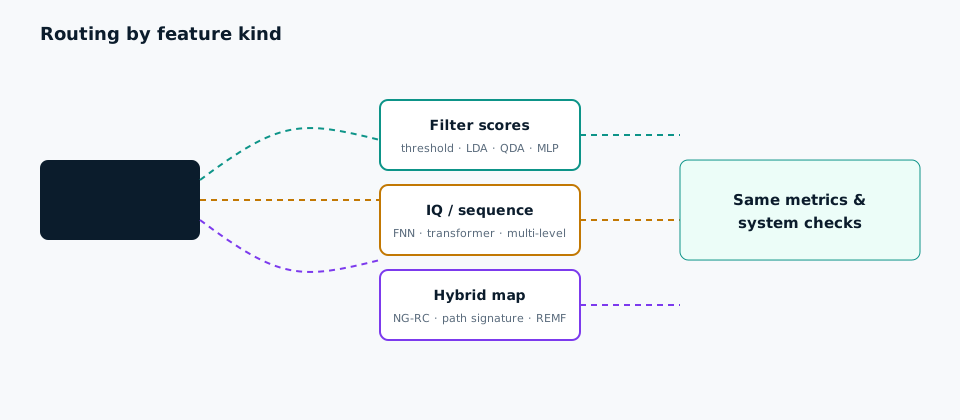
Classical methods score filter banks; neural and hybrid methods may consume IQ or expanded maps — then the same metrics and system checks.
Three attachment styles dominate the literature. The animation below cycles through them; the prose that follows contrasts what each style optimizes.
Matched and relaxation filters compress each IQ shot into a few scores. A threshold, LDA, QDA, or small MLP then cuts those scores. Fast, interpretable, and natural for FPGA-style stories.
threshold · LDA · QDA · MLP on filter scores
Networks learn directly from demodulated IQ (or from a filter bank feeding a neural head). Higher capacity when clouds overlap; heavier training and usually larger fabric estimates.
Lienhard-style FNN · HERQULES-style · multi-level / leakage heads
Expand the IQ trajectory into a rich but fixed feature map, then train a light linear or tree head. Bridges classical interpretability and learned capacity without a deep end-to-end stack.
NG-RC polynomials · REMF-style filter hybrids
Best when state clouds are already well separated after a matched-filter bank, or when latency and LUT budget dominate. Assignment quality is often competitive on clean multiplexed channels; the failure mode is overlap and time-dependent trajectories that a single linear cut cannot capture.
Best when the decision boundary is nonlinear in IQ or when multi-level leakage must be labeled explicitly. Gains show up as higher joint accuracy on hard qubits, at the cost of training complexity and larger analytical fabric estimates unless the architecture is deliberately compressed.
Best when you want more capacity than a linear filter cut without committing to a deep IQ network. Polynomial or signature-style expansions keep the head light; results depend on whether the expansion matches the physics of your traces under the shared protocol.
Under ARCADE’s shared recipe, these families are comparable because they see the same prepared traces and metrics — only the feature kind and classifier block change.
The headline public comparison on the five-transmon multiplexed dataset. Others are registered for paper recipes or experimental use.
Classical baseline
Per-qubit score cut after a matched-filter bank. Fastest classical reference for latency-sensitive stories.
Classical
Gaussian discriminants on the same filter-score matrix. LDA shares covariance; QDA fits per-class covariances.
Classical
A compact neural net on classical filter features — not the same path as the Lienhard-style IQ feedforward network.
Neural · paper
Fully connected classification on demodulated IQ traces. Strong accuracy reference when torch is available.
Neural · paper
Matched and relaxation filter banks feeding a neural head, oriented toward FPGA deployment. A leakage-aware variant adds multi-level decisions.
Hybrid · paper
Polynomial expansion of IQ trajectories with a ridge readout — hybrid capacity without a deep end-to-end stack.
Neural · paper
Treats higher transmon levels as first-class labels so leakage is not silently folded into binary error.
Gaussian mixture and naive Bayes models, support-vector machines, transformers on IQ sequences, REMF-style post-selection filters, and per-qubit ensembles are available for paper recipes and exploratory comparisons. Prefer paper-faithful recipes when claiming parity with a specific figure; prefer the shared reference recipe when ranking methods against each other.