Purpose
Why a common evaluation framework
Every published discriminator can look strong on its own traces. Deployment requires a comparable ranking under one protocol, resource estimates, and an answer to what that ranking means for NISQ circuits or fault-tolerant QEC cycles.
Every method shares the same prepared traces. Features are built for the method’s kind — filter scores, raw IQ, or a hybrid expansion — then a single classify block runs.
Optional compression and tuning stay behind switches. Fabric and latency estimates, then FTQC or NISQ system checks, consume the same prediction stream. You change the method block — not the experiment.
Classical thresholds, Lienhard-style networks, HERQULES-style hybrids, and next-generation reservoir features are therefore comparable under one protocol.
Primary focus for this project
Fault-tolerant quantum computing
Map assignment quality to readout error. Scale idle noise with acquisition time plus post-measurement control overhead. Report logical error rate versus duration and wall-clock cycle time = readout + control + decode.
Logical error and cycle time →Also in scope
NISQ operating points
From the classifier side: accuracy versus readout latency. Choose an operating point under your coherence budget; that point can later guide readout-pulse optimization.
NISQ framing →Reference evidence
One protocol. Many published methods.
The public reference comparison uses a frequency-multiplexed five-transmon superconducting readout dataset and ranks classical, hybrid, and neural methods under identical splits and metrics.
How to read this plane
Each point is one method under the shared five-transmon protocol. Higher is better assignment accuracy; left is cheaper analytical fabric cost (LUT).
Classical filter cuts sit near the low-cost side. Learned and hybrid methods climb accuracy at higher estimated fabric cost. Accuracy alone is not a deployment criterion — latency and the FTQC or NISQ ending still matter.
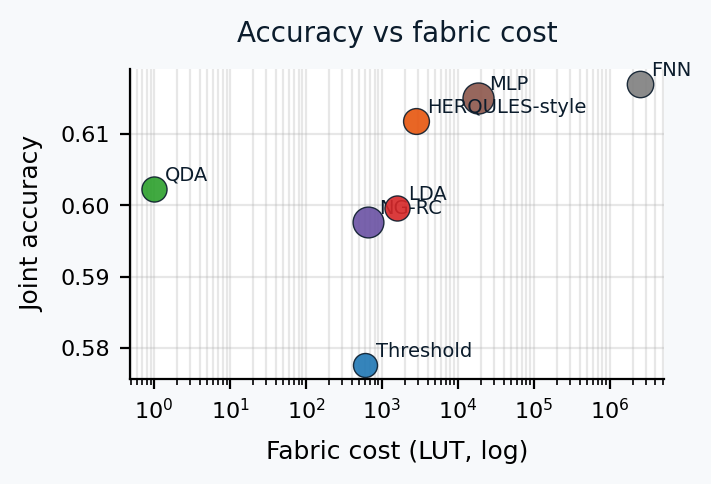
Marker size scales with estimated latency.
Shared evaluation recipe
What a fair comparison freezes
Methods disagree on architecture. They should not disagree on the experimental protocol when the goal is ranking. The shared recipe locks preparation, splits, and metrics so only the classifier block changes.
- Qubit system. Public reference: frequency-multiplexed five-transmon superconducting readout. Paper recipes may use their own traces — labeled as such.
- Preparation. Demodulation and preprocessing are shared so every method sees comparable IQ evidence.
- Splits. Train and validation partitions are frozen for the reference ranking.
- Features. Built according to each method’s kind — filter bank, IQ, or hybrid map — from the same prepared traces.
- Metrics. Joint and per-qubit assignment quality, plus analytical fabric and latency estimates when enabled.
- System endings. Optional FTQC logical-error curves and NISQ accuracy–latency views from the same predictions.
- Reproducibility. Canonical reference numbers ship as frozen curves and configs in the repository.
- Paper parity. Prefer paper-faithful recipes when claiming parity with a specific figure.
- Fair ranking. Prefer the shared reference recipe when ranking methods against each other.